

Many of us writers work on multiple projects at a time. Besides continuing to pursue publication for my memoir (Chasing Light: One Van, Two Dogs, and an Ex-Pastor’s Search For the Divine), I have an essay collection (Naturally Occurring Junctures) I’ve been working on that will soon be looking for a home. The book grew out of my MFA thesis project. Here is an excerpt from one of the essays in the book, “Hallowing.”
*****
I had not come to ordained ministry through the usual ranks. I used to joke with my seminary classmates, many of whom had fathers, uncles, grandfathers who had been pastors, that I didn’t have that Lutheran pastor strand on my DNA. I was a mongrel, muddying up the gene pool, I said.
I hadn’t gone to Lutheran church camp; I hadn’t grown up in a Lutheran congregation. In fact, I hadn’t really grown up with church at all, only the few places we belonged to for as long as we lived someplace, which was usually a year or two. One summer I went to my grandmother’s to stay for several weeks and probably due to all my wiggling and pestering in general, she enrolled me in vacation Bible school at a local Baptist church, which was unusual since she was Methodist. But she may have been desperate, and she had Baptist friends in her Homemakers Group.
We probably did some fun crafts and sang songs, and I would have liked both of those activities, but I don’t really remember anything about it. The only thing I do recall with utter clarity is that we were supposed to memorize the Beatitudes, and if we did, we’d win a little booklet with the words printed in it and tiny pictures of Jesus with children and clouds and angels. I practiced and practiced and on the last day made it through half of them, then floundered. The teacher gave me the book anyway. I kept the book for years but always felt like a phony whenever I looked at it.
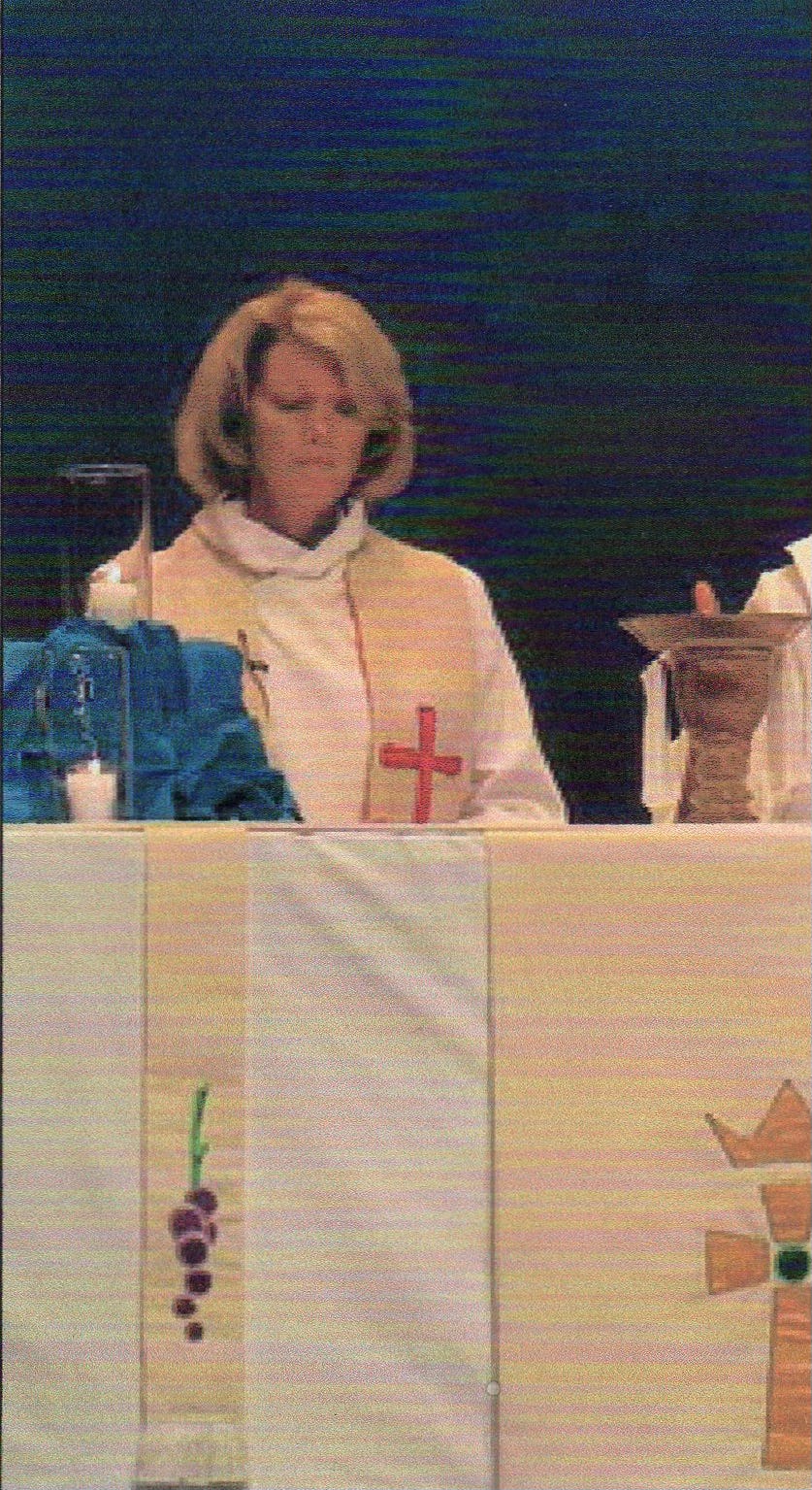
For a while after I left my last parish I was a sub, preaching at small congregations too strapped to hire their own pastors or providing coverage to give a current pastor an opportunity for vacation. More and more, though, whenever I put on my robe I felt as if I were costuming for some kind of production, where I was playing a part I no longer felt suited for.
After six months, I asked to be removed from the roster so I could make a clean break. My bishop sent a terse email filled with italicized and underlined words, reminding me that if I were ever to change my mind I would have to go through the candidacy process all over again, a several year process in which you must make your proclamations of faith and submit to regular questioning by a committee of seminary faculty, pastors, and lay people.
Being taken off the roster is also referred to as “giving up your call.” In the bishop’s letter I was told I was not to refer to myself as ‘pastor’ any longer and would not be permitted to preside at communion. As an add-on at the end, there was a brief “thank you for your service.” I folded up the letter and shoved it in a desk drawer.
“Fuck ‘em,” I said to the dogs when they ran into my office to see why I was slamming things around.
In my new life as not-a-pastor I wonder what to do with myself on Sunday mornings. The rules are clear about not returning to worship in a congregation you have served. Doing so undermines new leadership and muddies the relationship forming between new pastor and church members.
One Sunday I visit a Baptist church and it is fine, the people are warm, the music is palatable, and the sermon is okay, but I feel no pull to return. Another Sunday I accompany my then-partner to a nondenominational church where a friend of his is preaching. The minute I step in the door, the hair on the back of my neck stirs, and I know I am in enemy territory. He talks passionately about “the world” and “sin” and “demons.” He speaks of women in such a way that I know he dislikes us, all of us. When we’d been introduced earlier my partner, also a former Lutheran pastor, told his friend we were in seminary together, that I used to serve the church that is practically next door. The man had smiled a shiny smile and narrowed his eyes at me.
“How nice,” he said.
Now, as he’s preaching he talks about Satan and trains his eyes on me. After the service he shakes my hand and when I try to pull back, he grips hard and won’t let go. “Thanks for coming,” he says, leaning in. I cannot get away fast enough.
Another Sunday. A Methodist church. My mother will be pleased, I think, but also maybe not. A rock band is playing the introductory music. The singer looks like Johnny Depp. The preaching pastor wears a grin that appears to have been permanently installed. He cannot seem to stop smiling.
I look around me. Some people smile, working hard to reflect his happiness back to him. A couple of men doze. The woman next to me is singing, loud and off-key.
All I can think about is lunch.
I suppose I am on some kind of quest. How did I end up a pastor, I wonder. Can I track back to see where the thread began, the thing I picked up and couldn’t resist following to see where it would lead?
I remember when I was eight years old and we were living in Knoxville, Tennessee. One Sunday morning at the small Presbyterian church my family had briefly joined, I experienced a sudden sense of Presence. Sunlight shone through a large stained glass window, and the light shattered like jewels over my sisters and me. I looked up at the window, blinking.
Something stirs deep inside at the memory.
“Let’s go to Knoxville,” I tell my partner one day, and so we get in my car and drive two-and-a-half hours to the city where I’d lived for two years, where I’m miraculously able to direct him to a place I had not seen in over four decades.
The church has grown to take up the entire block. He and I go inside through wide front doors and enter into a hushed, carpeted foyer with a front desk reception area. A cool-looking secretary asks if she may help us, but she doesn’t really sound as if she wants to. I ask to see the sanctuary.
“Why do you want to see the sanctuary?” she asks.
I feel like saying, “I am looking at places where I might hold my next Satanic ritual. The full moon is coming and I want to see if your altar can accommodate three live goats.”
Instead I tell her I attended this church as a child. She looks suspicious but unlocks the door anyway, swings it open for us.
“Five minutes,” she says as if she is the curator of a great treasure she is certain we wish to spoil. She is there to keep out the riff-raff. I want to tell her it’s already too late. We are entering the holy space with our own brand of professional cynicism. We will leave trails of it in our wake.
A Sunday morning. Late summer. From my front porch I can see the ultra-suede blue sky, smell the sweet scent of newly-mown alfalfa from the farm down the road.
From deep within the forsythia bushes comes a familiar call, loud and piercing, the Catbird who comes every morning. I have started calling him The Preacher.
His song is expansive. He brings the news of far-off meadows, distant streams and rivers. He describes to us his view of the hills dappled with shadows, of the houses and barns nestled into the trees. He sings of cars and trucks on gray highways that pattern the green countryside like tapestry thread.
According to him, all is glory.
The Preacher belongs to the genus Mimidae. He claims Mockingbirds and Crows as kin, and confuses the cats, imitating their cries.
The cats stop what they are doing, although they are not doing much, scattered around my feet on the porch floor. The female opens one eye, stretches, and glances toward the bird in the tree.
The Preacher is cranked up now, rolling out the Word in song with trills, chatters, chirps, and clicks, as if the Spirit has caught him and flung him up on yon tree branch.
A Phoebe sings in the background. I hear Sparrows and Cardinals. A handsome male Ruby-Throated Hummingbird makes a pass at the just-bloomed Devil’s Tongue blossom, slipping his elegant beak into one seductive red trumpet after another.
The Preacher wraps up his news, rattling with impatience. I hear one last decisive churrah and the itinerant is off to the next pulpit, leaving the wind chimes to offer a benediction. Leaving me to feel for the first time in a long time as if I’ve been to church.
“Amen,” I say, and again, “Amen.”
Oh I love this! Especially the arc from "giving up the call" to appreciating the sermon sung in your yard, and this delicious line: "The Preacher is cranked up now, rolling out the Word in song with trills, chatters, chirps, and clicks, as if the Spirit has caught him and flung him up on yon tree branch." Up on yon branch. BAM.
Oh, so close and personal, relatable and so so funny! Thank you for this behind-the-scenes view, especially the Bishop's missive upon your exiting the pastoral realm. I hope you publish your essays soon.